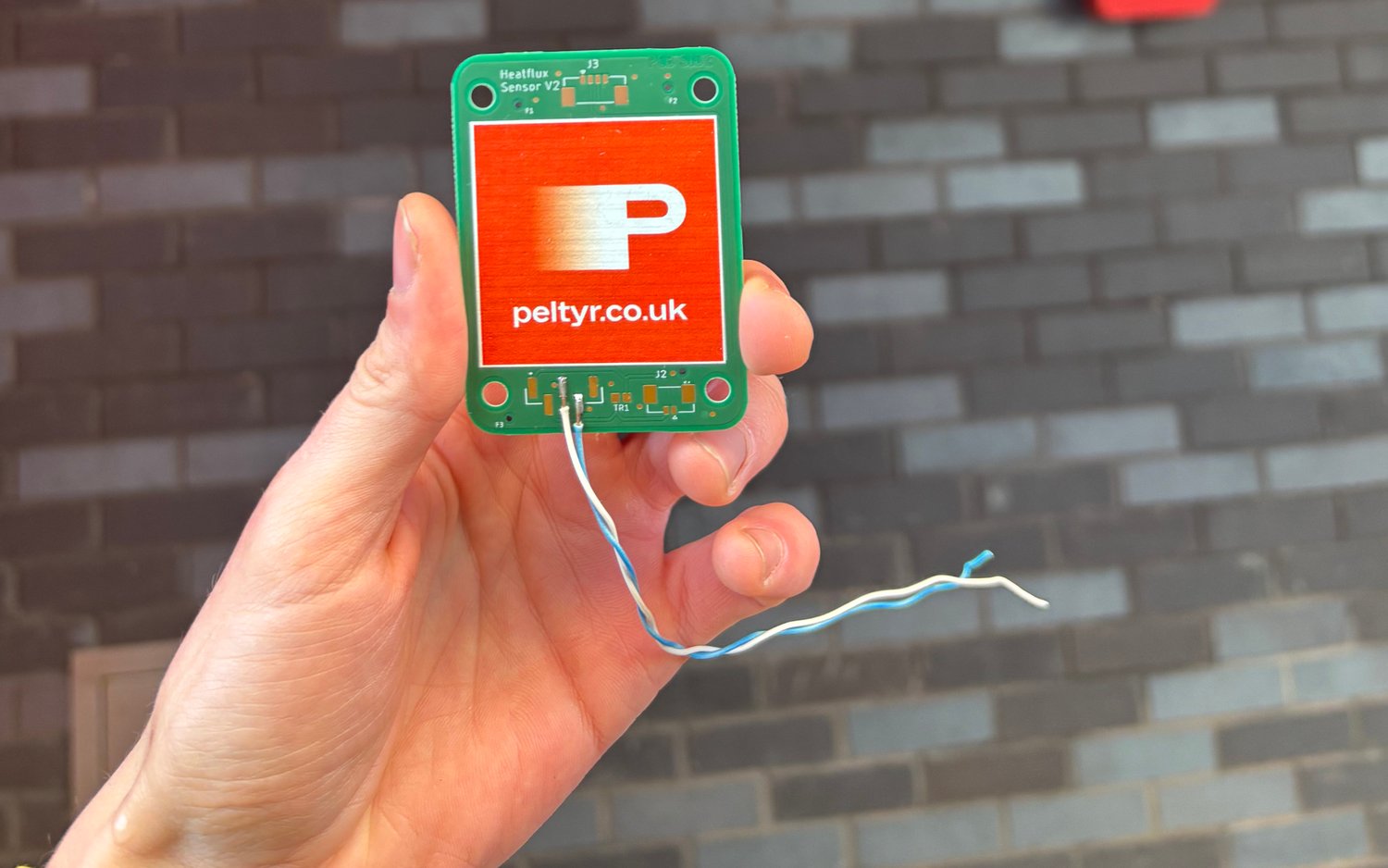
The sensor and what you get
What does a Peltyr sensor measure?
Peltyr measures heat flux density: the heat passing through a surface per unit area, expressed in W/m².
Its thermopile produces a small analogue voltage that corresponds to this heat flow. With suitable
logging, calibration and temperature measurements, the signal can support thermal performance
investigations and in situ U value measurements.
What is included when I buy a sensor?
The current product is a bare printed heat flux sensing element supplied with a short connection lead.
External data acquisition equipment, indoor and outdoor temperature loggers and automatic analysis
software are separate. Calibration is an optional addition. Check the product listing for the
configuration supplied with your order.
Is the sensor wireless? Is a complete kit available?
The bare sensor uses a wired analogue connection to external measurement equipment. Our packaged
measurement kit and wireless logging system are in development. Register your
interest for updates; confirmed availability and specifications will be announced when the kit is
ready.
How thin is the sensor?
The sensor board has a nominal thickness of 0.4 mm. This low profile can help where space at the
measurement surface is limited. Check the drawing for the supplied revision when designing a fixture:
board dimensions, connectors, leads and mounting materials all contribute to the installed footprint.
What are the measurement range and sensitivity?
The published heat flux range is ±200 W/m², with a nominal sensitivity of 4.7 µV per W/m². The
sensitivity is in microvolts, not millivolts. At nominal sensitivity, 10 W/m² corresponds to
approximately 47 µV, while ±200 W/m² corresponds to approximately ±940 µV. Use the individual
calibration factor where available.
Does the heat flux sensor need a power supply?
The thermopile generates its own voltage in response to heat flow and does not require an external
excitation supply. Your logger or readout electronics still require power. The separate thermistor,
where fitted, needs an appropriate resistance measurement circuit. Do not apply a supply voltage to the
heat flux output leads.
Signal, logging and wiring
How do I convert the voltage into heat flux?
Use q = (V − V₀) / S, where q is heat flux density in W/m², V is the measured voltage, V₀ is the
applicable measurement offset and S is the sensor sensitivity.
Keep the units consistent: dividing a corrected reading of 47 µV by 4.7 µV per W/m² gives 10 W/m². For
calibrated measurements, use the supplied calibration factor and instructions rather than the nominal
value.
What should I look for in a data logger?
Look for differential DC voltage inputs with suitable resolution, low input noise, low offset and drift,
and appropriate input impedance. The signals are small: at nominal sensitivity, a 1 µV error corresponds
to about 0.21 W/m². ADC bit depth alone does not establish measurement capability; assess the complete
signal chain at the sampling rate you intend to use.
Can I use my existing DAQ or a microcontroller?
Potentially. A suitable precision DAQ can record the analogue output for your own analysis. A
microcontroller will generally need an external precision ADC and a carefully designed analogue front
end. Send us your equipment model and required measurement performance before ordering so we can
discuss the proposed setup. Compatibility should be verified for the specific configuration.
Why do some sensors have four wires?
The documented four wire configuration provides separate connections for the heat flux thermopile and
an onboard 10 kΩ NTC thermistor. The thermistor is a resistive temperature sensing component; it is not
a thermocouple or an RTD. It does not replace the separate indoor and outdoor temperature measurements
needed for a building U value test.
How do I connect the sensor, and what determines the sign?
For sensors supplied with the documented brown, black, red and orange lead set, brown is the positive
heat flux lead and black is the negative lead. Red and orange connect to the separate NTC thermistor
circuit.
With the positive measurement input connected to brown, the documented blue to red heat flow direction
produces a positive output. Always confirm the wiring and orientation against the instructions for your
supplied revision.
Can I extend the connection lead?
Yes, but cable extensions and connections need care because the sensor produces microvolt level
signals. Poor connections, electrical interference and temperature differences at junctions can affect
the reading. Use suitable wiring and connections, provide strain relief, and check noise and offset
after extending the lead. Contact us if your installation requires a particular cable length.
Mounting, calibration and accuracy
How should the sensor be mounted?
Good thermal contact with the measurement surface is essential. Choose mounting materials appropriate
to the surface and experiment, minimise air gaps, and keep the setup consistent between tests.
The sensor and mounting layer can alter local heat transfer, so assess this effect where accuracy
matters. Contact us about your surface and fixture before selecting an adhesive or thermal pad.
Do I need calibration?
Calibration is recommended when you need quantitative heat flux results, comparisons against reference
equipment or a documented measurement uncertainty. It establishes the sensitivity of an individual
sensor under specified conditions. The nominal sensitivity is useful for initial evaluation, but should
not be treated as an individual calibration result.
Can I order a calibrated sensor?
Calibration is available as a paid option. Please tell us your application and any requirements for
calibration documentation, uncertainty or traceability. We can confirm the available service, price and
lead time for your order.
A calibrated sensor is one part of the measurement system; the logger, installation and analysis also
affect the result.
What determines measurement accuracy?
Accuracy depends on the sensor calibration, logger noise and drift, wiring, mounting, operating
conditions and analysis method. U value measurements also depend on temperature sensor accuracy, sensor
placement and the suitability of the measurement period. Discuss your required uncertainty with us so
the evaluation can address the complete measurement setup.
Can I access the raw data and analyse it myself?
Yes. The bare sensor provides an analogue voltage output, which your chosen logger records. File
formats and export functions depend on that logger and its software.
You can analyse the recorded voltage using the relevant calibration factor and combine it with
timestamp aligned temperature data. No Peltyr phone app is required to read the bare sensor.
Measuring a building U value
What equipment do I need to measure a building U value?
You need a heat flux sensor with an appropriate calibration, suitable data acquisition equipment,
indoor and outdoor temperature measurements, suitable mounting and wiring, and an appropriate analysis
method.
All readings need a consistent time reference. A USB DAQ may require a computer to remain connected
throughout the test; check how your chosen logger stores data.
How is a U value calculated?
For an appropriately configured test, the average method relates heat flux density to the temperature
difference across the building element. With equally spaced, aligned readings, the calculation can be
expressed as U = Σq / Σ(Tᵢ − Tₑ), giving W/(m²·K).
Validity depends on the measurement arrangement, test conditions and convergence criteria. ISO 9869-1
describes the heat flow meter method and its measurement and reporting requirements.
How long does a U value measurement take?
Allow several days. A 72 hour period is a common minimum starting point for suitable tests; elapsed
time alone does not establish a valid result. Heavy construction, changing weather and heat storage can
require longer measurement. A one to two week allowance may be useful for planning, with the actual
duration determined by the applicable method and whether the results have converged.
What conditions make a U value test more reliable?
A sustained temperature difference between inside and outside helps produce a measurable heat flow
signal. Select a representative location, avoid direct solar exposure and local heat sources where
required by the method, and account for thermal bridges and changing conditions.
A simple temperature difference threshold cannot guarantee a valid result; plan the setup and analysis
together.
Can Peltyr replace a thermal camera?
The two measurements complement each other. Thermography helps identify surface temperature patterns
and possible thermal bridges. A heat flux sensor provides a local measurement of heat passing through
its measurement location.
One sensor cannot map an entire wall or building; distinct constructions and non uniform areas may
require multiple measurement points.
Can measured U values help with heat pump sizing?
They can help reduce uncertainty in the fabric inputs used for heat loss calculations, particularly
where the existing construction is unclear. Fabric heat loss is calculated from U value × area × design
temperature difference.
The heating designer must also account for ventilation, infiltration and the other relevant elements on
a room by room basis. A local sensor measurement does not itself determine the required heat pump
size.
Will a measured U value change my EPC rating?
A heat flux test does not automatically change an EPC rating. EPCs use prescribed assessment
methodologies and evidence requirements. Measured thermal performance can still inform retrofit
planning, investigate assumptions and support design decisions.
If EPC treatment is important to your project, confirm the applicable rules with your accredited
assessor before commissioning a test.
Other applications and ordering
Can the sensor be used outside building assessment?
The analogue heat flux output can be evaluated for other thermal testing applications, including
insulation assemblies, packaging development, heating and cooling products and measurement system
integration.
Suitability depends on the heat flux level, temperatures, surface contact, environment and required
uncertainty. Tell us about your experiment so we can discuss a suitable evaluation; application specific
performance needs to be established by testing.
What operating temperatures and environments are suitable?
Use the specification for the supplied sensor revision and confirm suitability for your intended
conditions. For elevated or very low temperatures, moisture, outdoor exposure, curved surfaces or
embedded installations, contact us before ordering.
The sensor, connector, cable and mounting materials all need to be suitable for the complete
installation.
How do I order, request a quote or arrange an evaluation?
Order through our website, or email
jonas@peltyr.co.uk for an invoice, quantity quotation or
application discussion.
For an evaluation, include your test objective, expected heat flux and temperature conditions, logger
model, quantity and required delivery date. If your delivery country is unavailable at checkout,
contact us to confirm shipping options and the total order cost.